Sprawl

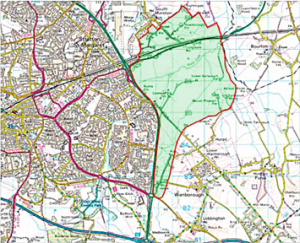
Swindon Eastern Development Area, from figure three of Swindon’s Core StrategyI first came across the Campaign to Protect Rural England (then known as the Council for the Protection of Rural England, CPRE) as a child living in West Sussex, when they seemed intent on having the majority of the county frozen at some point in an imaginary Victorian past. (They still do.) My impression then was of an organisation of city dwellers and rich commuters that knew little of the countryside and wanted to preserve it as a playground for the rich, regardless of the implications of that for rural communities. (The organisation’s original name included the word ‘preservation’ rather than ‘protection’.)

As someone who has now been a town dweller myself for twenty years, I’m really no different from my description of them, but nevertheless find the comments of the chairman of their North Wiltshire branch on the South West Regional Spatial Strategy still tainted with the same lack of reality. There’s much in what they say about the proposed eastern expansion of Swindon to supply the 36,000 extra houses imposed on us (as described in Swindon Borough Council’s Core Strategy) that I agree with.

There needs to be a major investment in water supplies, sewerage and public transport to support the proposed increase of 36,000 more houses in Swindon and an additional 13,000 new homes in the surrounding areas. Already there are instances of severe sewage overflow; the existing infrastructure cannot cope. It is time the Government listened to our concerns over building in the flood plains, for the protection of Coate Water, and for maintaining the separate identities of Swindon’s neighbouring communities.

There’s nought wrong with any of that. But then they go a bit off track.

Expansion outwards has left a dead centre and a fall in the economy.

To ascribe the problems of the town centre to the growth of the town is bizarre. On that analysis, city centres like Manchester, Sheffield and Nottingham should be long dead and feeding the daisies. As the CPRE also say, central Swindon needs regeneration, but that regeneration can never supply the sort of living environment that outward expansion — welcome or not — could.

Planned distortion

The difficulty planning authorities have rejecting any application without the decision being overturned on appeal is well known. Strength of local opinion counts for nothing if an application complies with guidelines set by central government. Whilst some degree of central influence is necessary, so that national needs are met, there needs to be a reasonable level of local flexibility and accountability too, otherwise the local planning process appears pointless: just another sham consultation to make the people feel good when there is no intention of listening. So when a constituent says

Ask any of them and they’ll say what difference does it make talking to your councillor? It’ll happen anyway.

you might think that any sensible MP would interpret that as a judgement on the excessive central government control of planning. Sadly, Ms Snelgrove though an MP is not sensible. In a distortion of reality Ms Snelgrove interprets it as an indictment of the abilities of the local councillors.

I think it is really worrying that so soon after a local election, when only 29 per cent of those eligible went to the polls, there is this level of disillusionment with the work done by councillors. Something has to be done to re-engage people with the democratic process.

It’s not disillusionment with the work done by councillors: it’s disillusionment with the lack of power councillors have. If you want to re-engage people with the democratic process, how about freeing councils of central government controls and targets, not just in planning but other things too, such as education and social services. No doubt the press would scream ‘postcode lottery’ at every opportunity, but at least there would be something worth voting for in local elections.

The wet approach to traffic management

I’ve heard a slightly different explanation from any given so far of why Swindon Borough Council wants to build a canal along its chosen route. The explanation came from one of the canal trust’s officers.

One of the features of Swindon’s traffic highlighted in the council’s Central Area Action Plan is the high proportion of traffic that passes through the town centre. The plan aims to reduce this, so that most of the traffic left is actually going to or from the town centre rather than just passing through. The aforementioned canal trust officer said the reason the council wants to build a canal down Faringdon Road and Fleet Street is as part of that traffic management scheme. So the potential traffic congestion that our recently elected councillor was complaining of in his election campaign would be intentional rather than an unwanted side-effect.

I’m not sure how good the canal trust officer’s information source is, but it’s certainly a slightly different slant on the possible benefits of a new canal.

Update, Tuesday, 13 May: To clarify, the canal trust officer’s view was that the main reason for building the canal down Faringdon Road was for it’s traffic management effects rather than because, as the council have said, that would be the best place in terms of its civic amenity and tourist attraction value.

Half and ride

Mr Jenkins of Thamesdown Transport claims that he wants to promote the park and ride bus services.

Both the council and ourselves feel that this is the best way forward to provide a park and ride service for Swindon. This is a very positive move and one that will secure the long-term future of park and ride in Swindon. It’s a very popular service and we really want to promote it during the off-peak times of the day.

By ‘promote’ he clearly means ‘advertise’ rather than ‘encourage more people to use’ as, upon taking over the service, Thamesdown Transport have cut it in half and on the northern half have increased the fares and decreased the frequency. Passengers on the southern half get a somewhat better deal with fares reduced, but the frequency is reduced as well and change will no longer be given. The northern half of the service is clearly being milked, not promoted.

There’s nothing wrong with making changes to improve profitability; there is plenty wrong with trying to pretend that you’re not.

Spinning the canal

Even when doing little more than regurgitating a press release, the Adver cannot resist applying a positive gloss in support of the proposals to re-introduce a canal to Swindon.

Canal would give town a big boost

THE plan to build a canal through the centre of Swindon has been given the thumbs up by a business expert. Paul Briggs, chief executive of the Thames Valley Chamber of Commerce Group, has said that a canal could provide a big boost to the town. He welcomed the project as a key element in transforming Swindon’s town centre into a leisure and visitor attraction, disposing of its dreary reputation.

Only one of those sentences is true: that Mr Briggs of the Thames Valley Chamber of Commerce said that the canal could provide a big boost to the town. Could. Not ‘would’ only ‘could’. The article then goes on to reproduce almost the entirety of the chamber’s press release, leaving out only the first paragraph. I’ll repeat that paragraph here, as it makes clear what Mr Briggs was supporting.

The Swindon Chamber of Commerce has welcomed proposals to debate the redevelopment of Swindon’s town centre through the creation of a focal waterway. The plans hope to attract people to Swindon by transforming the town centre into a leisure and visitor attraction, disposing of what some believe to be a dreary reputation.

That’s only a ‘thumbs up’ to debating the plans. It is a long way short of supporting the plans themselves. As the rest of the press release made clear, whilst he is clearly not an opponent of the plans*, there are many questions still to be answered.

* Anyone who thinks the impact of the canal could match that of the coming of the railway 100 years ago obviously has their rose-tinted spectacles on: the canal has already been and gone once, with limited impact; the impression left on Swindon by the GWR remains unavoidable.

Let the wind blow

Not surprisingly, the annual general meeting on Saturday of Westmill Windfarm Co-operative produced opinions totally dissimilar to those of campaigner Joanna Lambert, who regards the five wind turbines as a noisy eyesore. However, some of them are as prone to overstatement as Ms Lambert.

I think they are not only beautiful but absolutely vital to the survival of our species and the planet.

A lack of cheap electricity may be inconvenient, but it hardly threatens the extinction of the human race.

The AGM itself was an odd affair. Held in a marquee beside the turbines and run by a chairman who forgot that not only did motions need to be proposed and seconded but they also needed to be voted on. Then their were the questions and comments from the floor, a mix of a few logical questions concerning the future of the business, and a large number that were bizarre to varying degrees. There were people who clearly found the whole idea of making money from a business as abhorrent and suggested alternatives to people receiving interest on their investments. There were others proposing over-the-top technological solutions to non-existent problems: as one of the co-op’s advisers said, why bother with battery storage of power from windfarms when they’re connected to the National Grid? Others were keen to publicise their own schemes — watermills on the Thames seemed popular — or had parochial questions about their own interests. The overall impression was more parish council than efficient business.

One thing was indisputable: the turbines were quiet, with the sound of birds in the surrounding fields much louder than the swishing of the blades.

Measuring success

If the only measure of success for a project is that it meets its principle objective then, as rather inaccurately reported in the Adver, the changes to waste and recycling collections in Swindon have been a success, with an almost 60% increase in recycling*. However, a project also needs to be measured by what other effects it has and any well-managed project will have a number of other, secondary, criteria for success. Complaint levels of ‘20 or 30 a day’ may be low compared with the reported number of collections, 860,000 per month, but without a comparison with the number of complaints before the changes, is no measure of success. And if Mr Harcourt believes that ‘Swindon is now a tidier town’ then he’s clearly not set foot on the streets of central Swindon.

*Unlike the Adver report, I do know how to do percentages: an increase in the recycling rate from 27.3% to 43.5% is an increase in the recycling rate of just over 16 percentage points, or an increase of almost 60 per cent.

Market half-sense

I’m delighted to read that, at last week’s meeting of Swindon Borough Council’s planning committee, the latest plans for the tented market were deferred for consideration in June, with the chair of the committee describing them as unacceptable and officers recommending refusal because their appearance from Commercial Road is so poor. It’s nice to see that they agree with me, for once.

The developers say they will appeal if the plans are rejected: they are still open for comment, if you wish to add your weight to the officers’ opinion.

Big screen, small crowd

As mentioned in the comments to the Adver’s story and as apparent in the Beeb’s photo gallery of the launch of the big screen in Wharf Green, the crowd was small. Some may say that’s because of the timing (Friday afternoon) or the lack of publicity. However, both the small crowd and lack of publicity suggest that the town’s people have not been deceived by the hype that continues to follow the big screen.

This will instil a sense of civic pride in the people of Swindon.

There are many that criticise Swindon and its people. The lack of interest in this event shows that the aspirations of the people of Swindon and their perception of what would instil civic pride are above what the Beeb’s Mr Burnett-Godfree, and others who have over-promoted the big screen, would have us believe.

I also note from the comments to the Adver’s story that someone with pretensions (albeit fanciful) to represent South Swindon in parliament, has obviously not visited the town centre for a long time, nor followed the local news on which he chooses to comment.

Gain one, lose one: local elections 2008 – the finishing post

With the counting in the election now over, there’s hardly any change. The red nest regain a total grip on Central, taking the seat vacated by Ms Darker who has successfully run away to St Philips ward, but the blue nest have gained one of the two seats in Parks. I also see that the council leader Mr Bluh came second in Dorcan, where two seats were on offer, so he’ll be back up for election in two years’ time. ’Tis hardly a ringing endorsement of his performance, as a self-styled leader with vision, to be beaten by a novice.