No stars

Swindon Borough Council’s latest ‘scores on the doorsnews release has received plenty of publicity. But whilst the complacency of some of those in receipt of a zero star rating is to be deplored, the criticisms of the scoring by some more highly rated* cannot be ignored. The criticism is that the inspection regime is too paper based: an establishment can fail for not filling in the right paperwork, but can pass with poor hygiene if the paperwork is fine.

The information about what contributes to a restaurant’s star rating is rather well buried on Swindon Borough Council’s website. The criteria set-out by the government’s Food Standards Agency for assessing a ‘food business’ are:

  • type of food and method of handling;
  • method of processing;
  • consumers at risk;
  • level of current compliance with food hygiene and safety procedures;
  • level of current compliance with structure of premises;
  • confidence in management and control systems;
  • risk of contamination of food.

But of those, the only three that contribute to the ‘score on the door’ are:

  • level of current compliance with food hygiene and safety procedures;
  • level of current compliance with structure of premises;
  • confidence in management and control systems.

Oddly, ‘risk of contamination of food’ — logically the most important to the consumer — does not contribute to the score. Which might explain why the official definition for a zero-star rating is

Serious non-compliances found but no imminent risk to public health.

Until there’s an inspection regime that’s concerned more about food hygiene than it is about correct paperwork, my choice of restaurants will remain undisturbed.

* At which point I would have liked to have linked to their five star rating, but the council’s search result was broken.
Farewell Mr James

It has been announced that the New Swindon Company’s Mr James has stood down, apparently by Mr Richards of the South West Regional Development Agency.

Swindon has a problem with a negative image. We need to bring together the marketing of the town and the delivery of regeneration all under one roof. That is what’s behind the restructuring of the New Swindon Company. We are very satisfied with what Peter James has achieved and we wish him well.

Mr James seems to have a track record here. According to his profile, he has left a regeneration programme unfinished before.

Prior to joining The New Swindon Company, he spent three years with Tees Valley Regeneration as Director of Development.

A feature of Mr James’ leadership has been severe over-promotion of every minor step. Lets hope his replacement is someone capable of completing the job. One other point from the announcement stands out.

We need to bring together the marketing of the town and the delivery of regeneration all under one roof.

So far, much of the ‘marketing’ has been done by the New Swindon Company, but whenever it comes to ‘delivery’ Swindon Borough Council gets involved. If this is all to be brought ‘under one roof’ whose roof will it be?

Picture this… eventually

Last September, I commented on plans to set-up a central control room to monitor CCTV footage from the town centre that was acknowledged as being of questionable value. Almost a year later, and Swindon’s lollipop fans, the Swindon Community Safety Partnership, are once again talking about setting up a central CCTV control room, plus at least five more cameras to add to the forty already in existence in the town centre.

For someone who’s a volunteer policeman, Mr Palusinski, head of the Safety Partnership, has an almost criminal disregard for evidence.

The new system won’t be a case of Big Brother watching you – it is to tackle issues of crime and disorder in the town while making residents and shoppers feel safe.

Err… regardless of what it’s being used for, unless the control centre is left empty and unused, it will be a case for the big-brother state watching.

These area may be parts of the town that are heavily affected by violent crime, graffiti or purse dippings and aren’t covered by sufficient surveillance.

So that’s CCTV being used to monitor the crimes that the evidence shows it’s least effective in tackling (i.e. anything other than theft from cars in car parks).

The amount of money that will be spent on updating the network will be far outweighed by the savings that will be made by having one central control room instead of having to communicate with several different agencies.

Given that the Safety Partnership’s own report acknowledged that 80% of CCTV footage is of questionable value, it seems to me that the money spent updating the network will be a waste of money.

I’ve been monitoring the ‘initiatives’ of the Swindon Community Safety Partnership for over eighteen months now. I’ve yet to see anything that suggests their naïve leadership are doing anything other than wasting Swindon taxpayers’ money.

Update, Monday, 24 August 2009: To reinforce my point, an internal police report has found that of London’s more than a million CCTV cameras, only 1 in 1000 contributes to solving a crime each year. So Swindon’s cameras are likely to be useful less than once every 20 years.

Insecure marketing

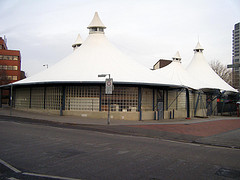
Back in business soon?It’s nice to see that the tented market may soon be back in business. But given the state of the economy, it seems odd that the market’s new owners have chosen to increase rents by 60 to 100%. They say that rents need to go up to allow them to make a profit. Well, yes, but the previous operators of the tented market wouldn’t have stayed in business for as long as they did if they were making a loss so big that it could only be cured by a hike in rents as vast as this.

What would tenants get for these inflated prices? Insecurity, though that’s not how the new owners see it.

The six month lease is there to give security to us and the traders.

The risk of being evicted within months of opening a new business isn’t what many would describe as ‘security’. Flexibility: yes. The ability to cut ones losses if the new venture isn’t a success: yes. Security: most definitely not.

Faultless addiction

It’s disappointing but no surprise that the comedy double act Ross & Field are once more doing their bit to ensure that Swindon is a less secure place to live. Mr Ross, it would appear, believes that people should not be held responsible for their own addictions.

He said Burrows tried to buy methadone illegally on the streets but eventually reverted to heroin and had to offend to fund the habit. Urging the court not to impose a jail term, he said: “The offence was committed out of desperation, desperation through no fault of his own.”

If a compulsive gambler hasn’t won the lottery yet, it’s not their fault. Would Mr Ross be happy for them to burgle his house to make up for the money they haven’t won? (If he could claim the legal fees for defending them, quite possibly.)

Yet another hotel proposal

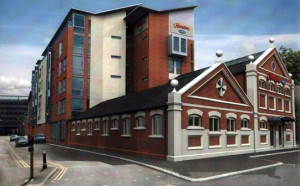
Oddest Victorian terrace I’ve ever seen.I know that the hotel business is said to be one of the few that is still doing well in the current poor economic conditions, but does Swindon town centre really need another 118 hotel rooms? That’s in addition to the 134 Holiday Inn Express and 229 Jurys Inn rooms opened in recent years. I ask because a planning application has just been submitted to convert the former Paragon Laundry on Aylesbury Street into a 118 room hotel. The application is full of the usual developer drivel about designing something that fits in with the local surroundings, even when the drawings show that it does no such thing. To quote from the design statement,

The massing of the proposed buildings relates not only to the immediate context but the wider Town Centre context.

In other words, the height of the hotel would completely dwarf nearby buildings: even the relatively new flats on Wellington Street are not as tall.

The middle and tall part of the building has been broken up into four main sections that correspond to the Victorian “rythm” (sic) of terraced houses.

If anyone can find nearby some six storey Victorian terraces without any doors and virtually no windows at ground floor level, I’d be very surprised.

The hotel will have only 14 car-parking places, apparently with agreement of council officers. The plan also says that ‘Public parking provision will be increased along Aylesbury Street’, that ‘In agreement with SBC, a drop off bay is proposed on Station Road’ but then contradictorily ‘the proposed redevelopment… will have no impact on the operation of the adjacent highway network.’ Given the frequent traffic queues in Station Road outside the proposed development, that seems highly unlikely.

The documents and drawings that accompany the proposal show it branded as a Hamptons hotel, part of the Hilton chain, though the status of their involvement is unclear from the application.

As yet another developer jumps on the hotel-building bandwagon, it’s difficult not to believe that in a few years time Swindon will have as big a surplus of hotel rooms as it currently has of flats apartments for rent.

Rejected… for now

It shows how well Swindon Borough Council presented their case that, on appeal, the Swindon Gateway Partnership’s application to concrete over the area surrounding Coate Water has been rejected following the planning inspector’s recommendations. This will no doubt bring on a certain amount of celebration by the campaigners that fought against the development. Any such celebration is misplaced.

The decision is quite clear about why the application was rejected. It’s also clear about which objections weren’t important. Most of the campaigners’ objections are in that latter group. In summary, the reasons why the development was rejected were:

  • impact on the views from Coate Water park, particularly towards Liddington Hill;
  • insufficient gap between the development and the eastern side of Coate Water park;
  • lack of confidence that the area on the site identified for a university would actually be developed as such;
  • detrimental influence on town centre regeneration that building offices and a university on the edge of town would have;
  • insufficient guarantees to ensure that the offices would be used as a science park linked to the university;
  • constraints on future expansion of the Great Western Hospital.

Objections that were not upheld were:

  • flood risk;
  • impact on views of Coate Water from Liddington Hill;
  • impact on wildlife;
  • proximity to an Area of Outstanding Natural Beauty;
  • protection of archaeological heritage;
  • literary associations with Richard Jeffries.

From that list it can be seen that most of the campaigners’ objections were cast aside, whereas the objections from Swindon Borough Council — so often criticised by the campaigners — were upheld.

There’s one other feature of this decision that seems to have been overlooked by those celebrating the rejection of the application. That’s the support in principle from the inspector and minister for housing development on the site.

The Secretary of State agrees with the Inspector that… the appeal proposals have the potential to deliver high quality housing,… make a meaningful contribution to identified housing needs and are in a suitable location in principle for an urban extension. He gives significant weight to this factor.

He has given considerable positive weight to the contribution the proposal would make to easing the identified shortfall of housing in Swindon, including the provision of affordable housing. However, the Secretary of State considers that this needs to be set against other factors including the proposal’s failure to use land effectively and efficiently, due to its excessive land take in respect of the university campus.

In other words, a revised application, with houses in place of a university, may well succeed. The fight for the area around Coate Water is far from over.

Orphaned radio

Not for the first time, Brunel FM finds itself orphaned. With the news that its latest parent company has gone into administration, the station stumbles on, as does the speech of some of its presenters. Its last owners have done the job of improving the station’s output, despite some of their sillier attempts at self-publicising — though to be honest it would have been difficult to be worse than it was. No doubt if the parent company hadn’t been so short of money and forced to spread its few good presenters around its stations, things might have been better still and the other presenters more eloquent.

What, of course, the station’s owners past or present can’t do is change the fact that there’s a limit to how much radio advertising one town can sustain. The regulator ofcom sets rules that allow holders of local radio licences to — after the first few years — ditch virtually all their local commitments and effectively become the local branch of a national station. They then let another licence, in an attempt to reintroduce some local element to the broadcasting, for the first few years of the licence…. And so the cycle continues.

Four ‘local’ stations — even if two of them aren’t dependent on advertising — seems to be more than Swindon can sustain.

Safety in numbers

Whatever happened to investigative journalism? According to the Adver’s editor, his journalists ‘give the news a dose of perspective.’ Not when they’re reporting police statistics they don’t. Yesterday, they reported a police survey of crime concerns in Pinehurst. It wasn’t the most comprehensive survey.

Officers surveyed people living in the Tree Courts area following a three month long crackdown on crime and antisocial behaviour. More than 50 questionnaires concerning crime issues were sent to homes in the area.

Tree Courts is just a small part of Pinehurst, but the Adver didn’t let that fact get in the way of the headline.

Pinehurst people feel safe – survey

That this was a small unrepresentative survey went uncommented upon by the Adver’s journalist, though not by their readers.

84% people who responded said they felt safe where they lived.

Looks impressive, except that only 38 of 55 surveys were returned, and no indication is given of how many answered each question. So, to put some of the Adver’s percentages into numbers of people, at most:

  • 32 people said they felt safe where they lived;
  • 18 people felt antisocial behaviour had decreased as a result of the police operation;
  • 24 people were happy with the multi games use area opened in July.

Presented like that, the survey results look much less impressive.

Packing them in, Hab-style

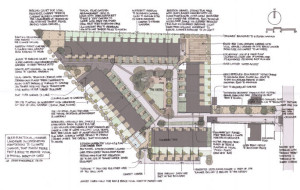
Mr McCloud has been keen to promote his environmental credentials. He’d also have us believe that he’s an imaginative developer. Now that his HAB company’s plans to infill an area behind Northern Road — what they have unimaginatively called The Triangle — have been submitted, we can judge for ourselves.

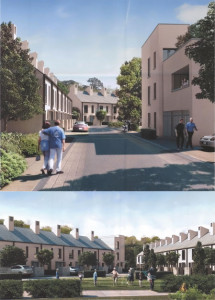
Not the Railway VillageLook at the two artist’s flights of fantasy. The scenes look just like the Railway Village, don’t they? Don’t they? They don’t. Gone is the pebbledashing of his earlier plans, replaced with render, allegedly to match the surrounding 1930s semis and, if the spin is to be believed, for its energy efficiency.

The development has been set out to achieve high-energy performance targets; this has led to us looking at rendered façade types as the most effective way of achieving these targets.

No doubt, the fact that render is a most effective way of hiding cheap materials underneath never crossed their minds.

They also claim that the monstrosities at the ends of their terraces are inspired by the Railway Village. To quote again from the planning application’s design and access statement,

Further south and just off the town centre is the Railway Village…. These terraces are generally terminated to their ends by a three storey building. The terraces have an area of defensible space to their front allowing for a degree of privacy, and compact well functioning yards to the rear.

Compact well functioning? That’s ‘small’ in plain English. And the three storey buildings in the Railway Village have considerably more in common with the surrounding buildings than Mr McCloud’s bland slabs have with the rest of his development.

McCloud packs ‘em inYou’ll notice in the artist’s impressions fantasies there’s plenty of large cars parked in front of the houses. That’s because despite earlier intentions, the reduction they’ve made in the number of parking spaces per house is concentrated entirely on the smaller, cheaper houses, giving a reduction of less than 30%. And what space they have saved by providing for fewer cars seems to have been used to pack more houses in rather than allowing more space around the houses. If you want a garden, this isn’t the place for you.

What the developers describe as a ‘Multi-functional, humane landscape incorporating adaptations to climate change that places people first & seeks to reduce visual & physical impact of cars’ to me looks — a few wooden fences excepted — incredibly similar to other developments in central Swindon.