What do the less diligent councillors do?

Yesterday, the Adver reported on a week in the life of three councillors: Messrs Tomlinson, Pajak and Montaut. All three seem keen to stress how much more there is to their public service than attending council meetings. I wouldn’t deny that. But all three of these councillors have had quite good attendance rates at meetings. It comes as no surprise that they are as diligent when away from the council offices.

What would be more interesting is to see the diaries of Messrs Wiltshire, Dobie and Baker. Do they make up for their poor attendance at council meetings with their other councillor duties, or do they put in a matching performance?

On the wrong track

One of the common features of pressure groups and campaigns is their one-tracked pursuit of their goals, impervious to whether the approach they are taking is so inappropriate as to actually prevent them being taken seriously, ultimately reducing the likelihood of them achieving their goals. So it is with the New Mechanics Institution Preservation Trust. They will be making representations to the planning inspector who is currently assessing Swindon Borough Council’s Central Area Action Plan. The plan covers many things and the Railway Village is a relatively small part of that… and the Mechanics Institute an even smaller part still.

Don’t get me wrong, it’s perfectly appropriate for the Mechanics Institute to be a topic for discussion during the inspector’s examination of the action plan, but her remit is limited to issues of planning policy and strategy. Who owns individual properties is not a planning policy matter. Using the examination, as they are, as a means for yet again peddling the Preservation Trust’s view that the Mechanics Institute should be in their their ‘community’ ownership for community use is way beyond what inspector’s remit. Wasting everyone’s time making arguments that aren’t relevant just annoys and detracts from the small smattering of arguments in the Trust’s case that the inspector can consider.

If they want to yet again be labelled as vexatious, the New Mechanics Institution Preservation Trust seem to be going the right way about it.

A big cleaning bill

I find Swindon Borough Council’s approach to fly-posting both half-hearted and inefficient.

The cost of removing a poster zip-tied to a tree or lamp-post is about £20 while a poster fixed to another surface could cost up to £200…. Mr Palacio said: “We are keen to stress that we are not trying to ban anyone from putting up posters – we just want to make sure that they are not left lying around for ages after the event is over.”

I can see that something that is very firmly glued in place may be expensive to remove, given the staff time and equipment needed — steam cleaning, for example. But £20 to remove a poster tied to a tree? Even if this includes the cost of someone at the council’s contact centre dealing with a report first, there must be a very inefficient process between the first report and the final snip to remove the poster to run-up a bill of £20. And why wait until after the event to get tough with the culprits? Fly-posting of the type shown in the Adver’s story is unsightly from the moment it is posted, not just several months later.

Planning non-access

No access here!Having lost their website for a few days last year, Swindon Borough Council is now having problems with the part of their site that gives access to planning applications. This is supplied by a different company from the main site and consistently does not work outside of normal office hours. Most weekends for the last few months it has suffered from frequent out-of-memory errors if you try to access the document linked to an application or, as it has since at least Friday, just refuses to give access at all. According to the software suppliers, their software

is designed to provide Planning & Building Control departments with an efficient means of realising e-government targets quickly, whilst taking the stress and risk out of administering applications, both online and offline. It is a ‘hands off’ approach, so that case officers can get on with value-added work – not ‘pushing’ paper.

Perhaps it’s time the council took a rather more hands-on approach and pushed their suppliers to provide a service that delivers what it is meant to and what we, through the council tax, are no doubt paying for.

Lies, damned lies and crime statistics

If you’re reporting a story that does little more than regurgitate some press releases, you’d at least try not to make any errors in what you copied, no? Step forward the Adver which, in publishing a story based on a press release from Wiltshire Criminal Justice Board, has managed to misquote the figures from an Institute for Public Policy Research (IPPR) press release.

The number of youths cautioned for criminal offences has grown 12 per cent in the last six years. The number convicted of a crime rose by three per cent since 2002.

What the IPPR figures actually stated was that the number of youths cautioned or convicted for criminal offences has grown 12 per cent in the last six years whereas for adults the rise is three per cent.

The Wiltshire Criminal Justice Board’s response to the IPPR report is to claim that the number of youths cautioned or convicted for criminal offences has decreased by 13 per cent in the last two years. In a later press release they go even further.

In the past three years we’ve seen a fall of nearly 40 per cent in the numbers of young people entering the youth justice system.

Well, that’s comforting isn’t it? No mention of detection rates or of the numbers of crimes being reported. As long as convictions are dropping, everything’s fine.

On the basis of the analysis done by the Wiltshire Criminal Justice Board, we’d be far safer if the police were abolished, because then no children would be convicted or cautioned. And regardless of what has happened in the last two years, by the boards own measure, youth crime is 12 per cent higher than six years ago. Just two years of figures are hardly evidence of a downward trend.

Town on track for low-speed trains

FGW strolling through the grassI see that the Adver has a report on a feasibility study by Network Rail on five possible high speed rail lines, one of them through Swindon.

One of the proposed lines would run alongside First Great Western’s London to Bristol route and that could see trains transporting Swindon rail users at speeds of 100mph.

Perhaps the reporter is too young to remember when the trains that run the current mainline service through Swindon were introduced and called the InterCity 125 because they ran at 125 mph… as they still do, on a good day, on the line between Swindon and Didcot.

Swindon LINk

Yesterday I attended the inaugural meeting of the Swindon Local Involvement Network (LINk), which has been created to monitor and comment on public-funded health and adult social care in Swindon. It has limited powers: just the right to ask questions of NHS services and the council’s scrutiny committee and to insist they answer within a set time.

The meeting was an odd affair. I had signed up in response to a flier enclosed with my annual Council Tax bill. Until yesterday I knew nothing of the history behind its creation. LINks replace, though with a wider remit, Patient and Public Involvement Forums, which had been created then abolished by the government in the space of five years. All but three of those that turned up to the inaugural meeting — a grand total of thirteen — had been members of those forums, several with fairly blunt axes to grind about the re-organisation. Others seemed almost as interested in setting-up a complicated committee structure and what the procedure would be for their travel and subsistence claims than they were in health and social services. Almost all were retired: apart from the officers from Swindon Borough Council and Voluntary Action Swindon there in support, I was the youngest person. Hardly a representative group. There is a target for 2000 people to be involved. So far, only thirty have expressed an interest. It has a long way to go.

The first thing the Swindon LINk has been asked to provide an opinion on is the new ‘GP-led health centre’ to be built in central Swindon. One can only hope that it has become a larger and more representative group before it gives a response.

Packing ’em in at Coate

Packing houses in, that is. With even the ever-optimistic Mr Bluh admitting that residential development around Swindon is slowing, you might think that the pressure to concrete over the area around Coate Water might have eased. Not so. The Swindon Gateway Partnership (Persimmon and Redrow) is back with revised plans for 1,550 little boxes houses and a mystery university. It’s good to read that the council don’t intend to let the developers get their way until there’s evidence that the prospect of a university occupying the site is reality rather than fantasy. With public funding of universities stagnating (apart from what looks like a pre-election spending binge during the current financial year) that’s shouldn’t be too soon.

Yet another plan for the Tented Market

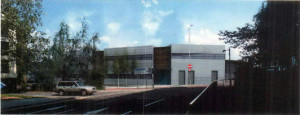
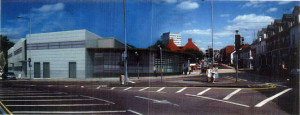
How pretty!The developers Clarebrook and their interior designers architects Pennington Robson are back with revised plans to replace Swindon’s tented market with what they rather fancifully describe as a ‘pavilion’.

Half a pavilionNow, credit where credit is due, the revised plans are an improvement on their last ones. That’s not a great endorsement. Their last design was incredibly ugly. So ugly that the planning committee deferred decision on them. The appearance from Commercial Road in the new plans is improved. However, anyone approaching from Farnsby Street — which, as a result of the one-way system, many do — will see a building remarkable only for its drab ugliness.

The plans are open for comment until 3rd July.

Swimming against the tide

The Adver seems to be trying to out-do Mr Bluh’s extreme optimism. In his words,

It would be very easy to sit here and be full of doom and gloom about the year to come. But I think we have got grounds to be optimistic. We are on a long journey and it doesn’t matter how much flood water there is we will keep on that road. We are focussed on business as normal but we have to be realistic about the challenges that will face us.

To me that reads as though he believes regeneration will continue but not at the same pace as was originally hoped. To the Adver, it translates as ‘full steam ahead’. You don’t need to have listened to much political spin to know that when a politician talks about a ‘long journey’, the journey will be longer than they originally predicted. With the forthcoming signs of progress being yet more demolition — this time at the former Swindon College site — rather than construction, Mr Bluh’s ‘optimism’ is little cause for excitement.