Tag: bad economics

Planning non-access

No access here!Having lost their website for a few days last year, Swindon Borough Council is now having problems with the part of their site that gives access to planning applications. This is supplied by a different company from the main site and consistently does not work outside of normal office hours. Most weekends for the last few months it has suffered from frequent out-of-memory errors if you try to access the document linked to an application or, as it has since at least Friday, just refuses to give access at all. According to the software suppliers, their software

is designed to provide Planning & Building Control departments with an efficient means of realising e-government targets quickly, whilst taking the stress and risk out of administering applications, both online and offline. It is a ‘hands off’ approach, so that case officers can get on with value-added work – not ‘pushing’ paper.

Perhaps it’s time the council took a rather more hands-on approach and pushed their suppliers to provide a service that delivers what it is meant to and what we, through the council tax, are no doubt paying for.
Utility trash

Over recent years, utilities and banks have been encouraging their customers to ‘go green by abandoning paper bills and account statements in favour of online account management. The aim, so the marketing went, was to save both them and us money and also save a few trees. It seems they were, on two counts, lying.

In the last few weeks I have received new customer magazines from Virgin Media and HSBC. Virgin’s Electric! magazine was such mindless, irrelevant drivel that it went in the recycling bin within five minutes of me receiving it. HSBC’s Liquid is slightly less mindless, but every article is a blatant advert for their products. Don’t get me wrong, I’m not so naïve as to expect a ‘free’ magazine that is not primarily an advert, but I do expect it to be slightly less blatant than the all-out sell, sell, sell produced for HSBC by Wardour Publishing. It too is now in the recycling bin.

So now I am receiving more paper from the utilities and banks than I ever did before and it is trash which, if it were included in the mailings that came with my bills and account statements, I could chose to opt out from.

Making a crisis out of a slowdown

Mr Hudson of Allen & Harris estate agents seems to have a very short memory, less than three days to be precise. On Friday, he seemed to be worried that supply is exceeding demand and house prices are falling.

Allen & Harris manager Steve Hudson said: “This month we saw 20 people agreeing to reduce their house prices in order to create more activity and get moved. Some people are also looking to sell and then rent while waiting to buy later to pick up a bargain.” He has seen a drop of around £7,000 from houses priced at the Swindon average of £149,000.

Today, his worries have reversed and he fears that demand might exceed supply.

Manager Steve Hudson, from Allen & Harris, fears that cutbacks [in new house building] could mean demand is not met. “The last thing we need is a housing shortage.” he said.

If people want house prices to rise, then what they need is a housing shortage. If they want prices to drop, they need over-supply. ’Tis the simple economics of supply and demand. If one considers the large numbers of people who wish to buy but can’t in the free market, and so are dependent on social and ‘affordable’ housing, that suggests there is a real need for house prices to fall, for everyone’s benefit. (Every ‘affordable’ house built — 30% of all major new-build in Swindon — has to be paid for by the profits made on all the other houses built.) So, in that respect, Mr Hudson is correct and a housing shortage is not in the nation’s best interests. However, I suspect his motives are far less altruistic….

Sprawl

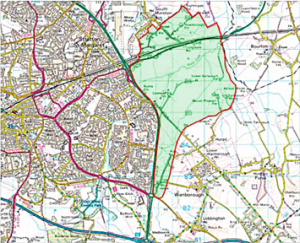
Swindon Eastern Development Area, from figure three of Swindon’s Core StrategyI first came across the Campaign to Protect Rural England (then known as the Council for the Protection of Rural England, CPRE) as a child living in West Sussex, when they seemed intent on having the majority of the county frozen at some point in an imaginary Victorian past. (They still do.) My impression then was of an organisation of city dwellers and rich commuters that knew little of the countryside and wanted to preserve it as a playground for the rich, regardless of the implications of that for rural communities. (The organisation’s original name included the word ‘preservation’ rather than ‘protection’.)

As someone who has now been a town dweller myself for twenty years, I’m really no different from my description of them, but nevertheless find the comments of the chairman of their North Wiltshire branch on the South West Regional Spatial Strategy still tainted with the same lack of reality. There’s much in what they say about the proposed eastern expansion of Swindon to supply the 36,000 extra houses imposed on us (as described in Swindon Borough Council’s Core Strategy) that I agree with.

There needs to be a major investment in water supplies, sewerage and public transport to support the proposed increase of 36,000 more houses in Swindon and an additional 13,000 new homes in the surrounding areas. Already there are instances of severe sewage overflow; the existing infrastructure cannot cope. It is time the Government listened to our concerns over building in the flood plains, for the protection of Coate Water, and for maintaining the separate identities of Swindon’s neighbouring communities.

There’s nought wrong with any of that. But then they go a bit off track.

Expansion outwards has left a dead centre and a fall in the economy.

To ascribe the problems of the town centre to the growth of the town is bizarre. On that analysis, city centres like Manchester, Sheffield and Nottingham should be long dead and feeding the daisies. As the CPRE also say, central Swindon needs regeneration, but that regeneration can never supply the sort of living environment that outward expansion — welcome or not — could.

Half and ride

Mr Jenkins of Thamesdown Transport claims that he wants to promote the park and ride bus services.

Both the council and ourselves feel that this is the best way forward to provide a park and ride service for Swindon. This is a very positive move and one that will secure the long-term future of park and ride in Swindon. It’s a very popular service and we really want to promote it during the off-peak times of the day.

By ‘promote’ he clearly means ‘advertise’ rather than ‘encourage more people to use’ as, upon taking over the service, Thamesdown Transport have cut it in half and on the northern half have increased the fares and decreased the frequency. Passengers on the southern half get a somewhat better deal with fares reduced, but the frequency is reduced as well and change will no longer be given. The northern half of the service is clearly being milked, not promoted.

There’s nothing wrong with making changes to improve profitability; there is plenty wrong with trying to pretend that you’re not.

Tempting fate

You’d think that, with the reputation large public-sector computing projects have for being late and over-budget, any public body would want to avoid headlines blagging about multi-million pound savings from some new gee-whizz integrated computer system. Wiltshire County Council clearly has a lot to learn….

Business streamlining project will save up to £11m a year
A project to streamline the way Wiltshire County Council supports front-line services has taken a significant step forward.
Members of the county council cabinet have selected Logica to work with it to enable many internal services to be provided much more efficiently.
The business management programme will simplify and standardise the way many processes such as invoicing, procurement, payroll and human resources are undertaken, through the reorganisation of services and the installation of a new, fully integrated computer system.
The move will potentially save the new One Council for Wiltshire between £9m and £11m a year after the initial investment of £8m is repaid.

It’ll only take a little over-optimism on how big the savings will be, combined with some traditional public-sector mismanagement of the computer project, for those savings to shrink to zero.

If you’re going to splurge vast sums of money of IT consultants and feel the need to publicise it, ’tis far wiser to do it somewhere nobody will look.

Turning out the lights

Wiltshire County Council is planning some new lighting schemes which they claim will save up to 50% on energy use in summer. The saving is obtained by turning the lights in housing estates off in the middle of the night when nobody’s about. This, apparently, requires a high-tech system with central control.

Does nobody in local government remember the low-tech option? komadori can remember timer-controlled lighting, replaced in the late 1970s, which went off at 1 am and came back on at 5 am. No central control room, no expensive electronics, same effect. Such is ‘progress’.

Making it up as he paddles along

Some organisations make odd choices for the people they put forward as their public representatives. Take the Swindon branch of the Wilts & Berks Canal Trust for example. Rather than putting forward someone with a robust knowledge of both the canal’s history and the current proposals for its reinstatement, they instead put forward their chairman, Mr Cartwright, whose knowledge of both seems to be distinctly lacking. Consider his comments on the canal history.

From an historical point of view the reason the canal was closed was because of its threat to health.

Err… no. After it closed, the canal was filled-in by the council on health grounds, but reason it closed was because it was a commercial failure, only making money for a short time during the construction of the railway and railway works in Swindon. Despite that short period of profit, neither its original promoters, nor its subsequent owners, recovered the money they invested. But enough history, what about today?

There is no £50m, so if the canal is not built the money will not be available to anywhere else. The regeneration of Swindon has been priced and the canal would add two pence in the pound to the cost.

Again, incorrect. If the canal plans were not there, the council could choose to levy a charge on developers to support other improvements in the town centre. As to the significance of the cost, Mr Cartwright should have a read of the implementation section of Swindon’s Central Area Action Plan. That identifies the cost to the council of developments in the town centre as £145m. That makes the cost of the canal thirty four pence in the pound, rather more than the two pence that Mr Cartwright suggests. Even adding in the boroughwide costs of the town centre redevelopment only brings the proportion down to fourteen pence in the pound.

If even its most ardent enthusiasts cannot make a coherent argument in support of reinstating the canal, is it in any wonder that so many in Swindon remain sceptical?

Failing to add up

Some of the documents in Swindon Borough Council’s budget consultation (which closes on Wednesday 6th February) give the distinct impression of knitted garments of ovine origin being used as a visual impediment. Having only looked at the summary, I’m already feeling distinctly dizzy.

In addition, the Council has identified a further £2.5m of savings that have no adverse impact on services received by the public.

These include:

  • securing alternative funding sources for services (mainly from health and schools)
  • Increased income levels (e.g. from increased leisure charges or specific Government grants)

If, instead of paying for a service through the council tax, I now have to pay everytime I use said service, whilst still paying the same, if not more, council tax, is that not an ‘adverse impact’? If a service is to be provided, someone, somewhere has to pay for it. In suggesting that it has become cheaper, a ‘saving’, when all that’s happened is that the point of payment has been shifted, the council is being rather economical with the truth.

Being taken for a ride

FGW great and smallHowever bad First Great Western’s rail service may be (and, undoubtedly, it is poor), today’s widely reported so called fares strike is nothing more than dressed up fares evasion. If you’re not satisfied with a product or service, don’t use it: buy from an alternative supplier. As the focus of the campaign is local trains around Bristol, not the mainline service to London, there are alternatives, such as local bus services or private car. But that would inconvenience the campaigners….

If someone suggested a campaign of shoplifting to protest about queues in supermarkets, I’m sure it would be met with derision. It’s strange that this campaign is not regarded in the same way.