Tag: Swindon

Student experience

With so little known about the companies behind the wireless internet scheme that Swindon Borough Council has put almost £½M of our money into, I’ve been doing a little investigation into the companies and the people running them. This isn’t going to be the most thrilling read, but there’s some information here that’s relevant to understanding the wisdom — or lack thereof — in spending public money on this wi-fi adventure.

Avidity Consulting Limited (registered no. 06990825) and Digital City (UK) Limited (registered no. 06990831) were both incorporated 14 August 2009 as DM 55 Limited and DM 56 Limited respectively, apparently as ‘off the shelf’ companies. Both changed to their current names on 18 September 2009 and one John Richard Hunt became a director on 21 September 2009 and 22 September 2009 respectively. Hitesh Kumar Patel became a director of Digital City (UK) Ltd on 26 September 2009. You may recognise that last named person as one of the authors of the Cabinet Member Briefing Note dated 12 October 2009 that recommended that Swindon Borough Council provide a loan of £450k to the company. There’s little to add about the facts of Mr Hunt’s record that he hasn’t said in public himself, though there are a few that seem to have slipped his memory.

The history of aQovia UK Limited (registered no. 06846037) is a little harder to follow. According to the company’s website it was founded in January 2008, which is the month after their internet address was registered. Companies House shows the company as having been incorporated on 13 March 2009 and that it has yet to file accounts. The company states that its managing director and founder is Muhammad Malik. Doug Berman is described as ‘a key member of the aQovia advisory committee’ though it seems less key to him as aQovia is without mention on his own recently updated profile. He appears to have experience of the wireless networking industry going back to 2002.

Mr Mustafa Arif became a director of aQovia UK Ltd on 16 September 2009 and has, apparently, also been a director of Digital City (UK) Ltd since September 2009. According to aQovia’s website he ‘has ten years experience of the telecoms and IT industries.’ However, for much of the last ten years — 1999 to 2003 and 2005 to 2007 — Mr Arif was a student. Whilst his studies were in topics (Information Systems Engineering, and Spacecraft Technology & Satellite Communications) of some relevance to his current role, time as a student is probably not what most people have in mind as ‘experience’ when reading the profile of a director. In the intervening two years Mr Arif was president of Imperial College students union or, as Mr Arif modestly describes it, ‘effective CEO of a £6 m+ turnover organisation.’ It seems that until 2007 Mr Arif’s ‘experience of the telecoms and IT industries’ was limited to his studies and a string of vacation jobs.

It is in such… err… experienced hands that almost £½M of Swindon tax-payers money has been entrusted.

Still unplanned

If I were someone who’d chosen, on the basis on minimal consultation, to stump-up almost £½M of local taxpayers’ money to the company intending to install wireless internet boroughwide across Swindon, I’d be feeling a little worried reading that company’s February update.

Things aren’t going according to plan. Just six weeks ago installation in Highworth was expected to be complete by mid-January. It’s now early February and work is still in progress.

[T]he installation in Highworth has not gone to plan. There are several reasons for this – topography, approvals and snow to name a few…. We have also had areas where there were no suitable lampposts and no public buildings to substitute. We have in the High Street spoken to retail businesses and begun to cover our black spots and hope to complete around the 15th.

Now I’m not aware of the approvals process for radio transmitters having changed in recent months. Nor have I seen reports of a mountain suddenly springing up in the middle of Highworth, nor of buildings and lampposts disappearing overnight. None of these could be regarded as unpredictable, and cold weather in winter is not a total surprise either.

Not only is the hardware side a bit awry, the marketing seems to have been off-target too.

Customer response in the main remains positive but we know we have frustrated many because we went live with the PR before we were ready, as a result are always playing catch up…. The following is our initial plan. In Highworth, from the end of February, we will carry out a leaflet drop, display window posters and place an advertisement in a community magazine. We will also be placing adverts for the free service (not yet designed) in as many public places as we will be allowed.

If they don’t know what the adverts will be nor where they will go, that’s more an initial guess than an ‘initial plan’.

To be fair, no start-up company will be anywhere near perfect: start-ups make mistakes… lots of them. And the openness with which the company is now talking about its progress is welcome. If this was all being done with private capital, whilst I might have a little fun at the company apparently being caught unawares by the presence of hills in the landscape, I wouldn’t be overly concerned. But this isn’t being done just with private capital.

There’s almost £½M of local taxpayers’ money invested in this. Taxpayers money invested in secret. Taxpayers money invested on the basis of a business case only a select few in the council have seen. A business for which the briefing to two councillors said marketing was key. If the business case was truly robust enough to warrant stumping up £450k of local taxpayers’ money, I wouldn’t expect things to be so far off plan as they are now.

Ripped up

With work on Thomas HomesSmith’s Quarter development resumed, it’s sad to see the majority of what was left of the traverser in the former GWR works ripped up. All that remains is the bare minimum that is needed to serve STEAM museum.
GWR traverser tracks ripped up.

More scrutiny required

It’s been brought to my attention that Mr Bluh’s been defending and promoting the efficacy of his not-so-little wifi deal. At a meeting of Swindon Borough Council’s Scrutiny Committee he almost showed a little humility. Almost.

He acknowledged the significant level of debate on the subject of the proposal to deliver a Wi-Fi network across the borough, particularly in relation to the decision-making process in reaching an agreement with Digital City (UK) Ltd

It would be rather shocking if he’d not noticed the very extensive debate.

He welcomed debate on how best to resolve issues of process that will allow the Council to take advantage of similar commercial opportunities that might arise in the future

As the evidence that this will be an opportunity rather than a liability has not been made public, I’d rather processes were in place to ensure secretive deals like this weren’t done in future.

[He] stated his certainty that the Wi-Fi network would prove to be a great success, one that would not only produce a financial return that would underpin service delivery for the benefit of residents, but one which presented an exciting commercial opportunity for private and public sector businesses and organisations in Swindon.

And why should I or anyone else in Swindon trust the business judgement of a politician and has-been lawyer? As it seems this decision was made in secret by no more than five people there’s clearly not a lot of trust around.

It was therefore essential, he felt, that the Council was prepared and able to pursue viable commercial opportunities, such as the Wi-Fi network, as they presented themselves.

A new internet provider in one of the best connected towns in the country doesn’t sound like the most sure-fire winner to me.

[H]e agreed that more openness generally was to be welcomed but he maintained that, if the proposal had been debated in an open forum, the “deal would not have happened”.

One of the purposes of open debate is to ensure that certain deals don’t happen. Nobody beyond a select few has been allowed to scrutinise the information that would allow them to form their own view as to whether this was a deal that should have happened.

He was aware of concerns about the decision making process and assured the Committee that the process would be reviewed.

And what happens if the review shows the process was flawed? Will Mr Bluh personally stump-up the almost £½M that has been gambled on the three start-up companies providing the wifi service?

However, he remained convinced that the proposal, which he was sure would be to the benefit of the council and its residents, could not have been successfully concluded if it had been made public any sooner than it was.

But it’s not really public even now. We have no detail of the basis on which Mr Bluh and associates made this decision — it remains a secret deal.

Councillor Bluh assured the meeting that the Council would not be required to make any further financial commitment to the Wi-Fi scheme beyond the initial £450k loan.

The council had no commitment to make the initial £450k loan, but a select band decided that it should. Why should we believe that if the company came back begging for more money, Mr Bluh wouldn’t choose — in secret — to stump-up yet more of our money?

Many questions have been asked so far about this deal. Some questions about the process by which this decision was made raise serious issues. Mr Bluh’s answer to almost all of them seems to be ‘Trust me, I know best.’ Until he provides more informative answers the scrutiny should continue.

Complete?

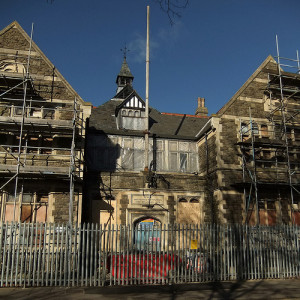
Swindon Borough Council recently suggested that if the owner doesn’t do some basic maintenance of the Mechanics Institute building within the next three months they may compulsorily purchase it. According to Mr Singh in his latest tirade against against the council,

the south side of the building is complete.

Mr Singh clearly has a rather draughty and scaffolding-clad view of ‘complete’.
Completely incomplete. Photo © komadori.
Complete… with draughts. Photo © komadori.
As for the remainder of the building, it’s condition is deplorable.
Mechanics Institute north side. Photo © komadori.Mechanics Institute fly tower. Photo © komadori.
As Mr Singh now says he is accepting offers, perhaps an organisation with the funds and experience to restore this neglecting building will express an interest. In many ways, it could be an ideal public venue to compliment the nearby headquarters of the National Trust.

New year, same inaction

It seems to be just once a year that Mr Singh — owner of the GWR Mechanics Institute building — appears from his self-imposed inactivity to claim a little publicity for his newest far-fetched plans for the building. The story is always the same: how he’s done so much to maintain the buildings; how great his newest plans for the building are; and how Swindon Borough Council and English Heritage are obstructing him. This year is no exception.

The way the council is talking it’s like I’ve abandoned it completely. People would be amazed if they could see what is actually going on inside.

So poor is the state of the building now that it’s actually possible to see rather a lot of the inside whilst standing outside. All I see going on inside is more decay.

It really is time Mr Singh understood that if the council is blocking his plans, it’s because that’s what the planning regulations say they should be doing. And if Mr Singh isn’t prepared to abide by the development control laws in this country, then he shouldn’t be in the property development business.

Re-railing The Park

Re-railing the park. Photo © komadori 2010.Work has started to reinstate the railings around Faringdon Road Park. Although they will be less substantial than the originals — the brick piers are not stable enough to hold full-height railings — they’ll lift the park’s appearance. It remain’s Swindon’s most barren of parks, bereft of the well-kept flower beds to be found in the parks around Old Town.

Some of the coping stones being removed are stamped with the manufacturer’s mark from 1897. They seem to have been carefully removed and will make a reappearance atop the rebuilt heightened piers.

Spatial squabbling

Both the blue and red nests seem to be keen to blame t’other side for proposals to build 3000 houses to the west of Swindon. The government’s representative in South Swindon, Ms Snelgrove, would have us believe that it’s all the fault of the blues.

Under current proposals Tory run Wiltshire County Council plan to build 3,000 new homes neighbouring West Swindon…. The Regional Spatial Strategy that sets out housing numbers for each local authority area was drafted by the Tory controlled Regional Assembly (now known as the South West Leaders Council).

Naturally, her opponent lays the blame on the reds.

Yesterday, Labour bizarrely criticised the Conservatives for the Regional Spatial Strategy, which has led to plans for 3,000 houses next to West Swindon. But only four months ago, Labour’s South Swindon MP strongly supported the RSS, saying, “it lays out important manageable growth figures for Swindon”.

As is so often the case in politics, all are suffering from selective memory loss.

The Regional Spatial Strategy is a consequence of the planning legislation introduced by the current government (red). The housing targets in it were set by the government (red). The strategy itself was produced by the South West Regional Assembly, now known as South West Councils (both blue). This is a document that seems to aim to solve the housing problems of rural Devon and Cornwall by building in the corner of the region that is furthest from those two counties — 34,000 houses were to be built in Swindon. Not satisfied with this distortion, the government (red) added another 2000 houses to Swindon’s allocation plus another 1000 in North Wiltshire in ‘urban extensions’ to Swindon.

Where to put those 37,000 houses? The Regional Spatial Strategy identified a large area to the east of Swindon, the Eastern Development Area. Swindon Borough Council (blue) in the first draft of their Core Strategy identified a number of other ‘areas of search’ where there could be significant development. One was at Tadpole lane. It also suggested where the urban extensions in North Wiltshire added by the government should be: near Ridgeway Farm and Moredon Bridge. Neighbouring North Wiltshire District Council (varying hues) objected to Swindon making plans beyond its border.

Now Wiltshire Council (blue, successor to North Wiltshire District and Wiltshire County Councils) is consulting on its own Core Strategy. It allocates land near Swindon’s western border for 3000 houses. In doing so it follows where the Government’s development strategy, the South West Regional Spatial Strategy and Swindon Core Strategy have lead.

With that provenance, neither main party is innocent in the conversion of Swindon into a suburban sprawl.

Burnt recycling

Whilst waiting for my first recycling collection of the year — the snowy weather has lead to the cancellation of the previous two — I’ve been browsing through Swindon Borough Council’s cabinet paper on plans for incinerating cooking Swindon’s rubbish. I couldn’t help but notice that rather a lot of what is sent for recycling seems not to be recycled.

The principal risk is how it deals with household waste, however, there is evidence that it will at least manage the residual waste from the Recycling Centre…. To fully manage our entire waste stream, an additional two units, on top of the three funded through this case, are required.

That rather reads as though the majority of the first two units will be used to burn leftovers from recycling. With 50% of Swindon’s rubbish actually being recycled, just how much more than that 50% is having to be weeded out? And given the oft claimed high quality of Swindon’s recyclables, just how little of what people elsewhere think they’re recycling is actually going to landfill?

What regeneration will Swindon get for £4.5M?

And how much direction to that regeneration will £150,000 buy? I ask those questions because £150,000 is roughly the size of the ‘package’ being offered for the chief executive of the replacement to the New Swindon Company.

  • £120,000 salary
  • £15,000 bonus
  • Removal and storage costs
  • Up to £4290 for temporary accommodation
  • 6 months weekly travel costs
  • Legal & estate agents fees plus stamp duty
  • £750 for ‘adaptations in the home’
  • Up to £8000 for relocation expenses

That’s roughly 10% of the new company’s budget of roughly £4.5M over 5 years going to its chief executive’s pay.

According to Mr Bluh

This is an exciting opportunity to lead and direct the regeneration and transition of Swindon, placing it on the national and international stage as a location open to inward investment.

Unfortunately Mr Bluh has been saying much the same thing for many years. There’s been far too much talk of visions, leadership and direction, but a woefully small amount of action, even allowing for the havoc wreaked upon the regeneration plans by the poor state of the economy.

We are seeking someone who has the appropriate leadership and entrepreneurial qualities and the ability to gain the support of public and private sector investors and the local community to deliver success.

‘Deliver success’? And whose version of success will that be? Surely it should be for this new company to support the public/local community and private sector investors to deliver success, not the other way round.

This is a pivotal time to shape the future of Swindon and in the process make your mark.

And that mark needs to be something considerably better than decorated hoardings around demolition sites, which is just about the only mark the New Swindon Company has left on the town.

This new company has a long list of things to do. It includes some such as a ‘University project’ that should be dead with the current state of government finance. Roughly £1.3M of our money is to be spent in the company’s first year, and a total of roughly £4.5M over five years, with a mission:

To deliver prosperity and a town everyone can be proud of.

Given the parlous state of public sector finances — both nationally and locally — we need to get considerably better value for our money than the regeneration has been so far.