Tag: Swindon

Yet another hotel proposal

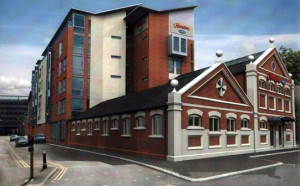
Oddest Victorian terrace I’ve ever seen.I know that the hotel business is said to be one of the few that is still doing well in the current poor economic conditions, but does Swindon town centre really need another 118 hotel rooms? That’s in addition to the 134 Holiday Inn Express and 229 Jurys Inn rooms opened in recent years. I ask because a planning application has just been submitted to convert the former Paragon Laundry on Aylesbury Street into a 118 room hotel. The application is full of the usual developer drivel about designing something that fits in with the local surroundings, even when the drawings show that it does no such thing. To quote from the design statement,

The massing of the proposed buildings relates not only to the immediate context but the wider Town Centre context.

In other words, the height of the hotel would completely dwarf nearby buildings: even the relatively new flats on Wellington Street are not as tall.

The middle and tall part of the building has been broken up into four main sections that correspond to the Victorian “rythm” (sic) of terraced houses.

If anyone can find nearby some six storey Victorian terraces without any doors and virtually no windows at ground floor level, I’d be very surprised.

The hotel will have only 14 car-parking places, apparently with agreement of council officers. The plan also says that ‘Public parking provision will be increased along Aylesbury Street’, that ‘In agreement with SBC, a drop off bay is proposed on Station Road’ but then contradictorily ‘the proposed redevelopment… will have no impact on the operation of the adjacent highway network.’ Given the frequent traffic queues in Station Road outside the proposed development, that seems highly unlikely.

The documents and drawings that accompany the proposal show it branded as a Hamptons hotel, part of the Hilton chain, though the status of their involvement is unclear from the application.

As yet another developer jumps on the hotel-building bandwagon, it’s difficult not to believe that in a few years time Swindon will have as big a surplus of hotel rooms as it currently has of flats apartments for rent.
Rejected… for now

It shows how well Swindon Borough Council presented their case that, on appeal, the Swindon Gateway Partnership’s application to concrete over the area surrounding Coate Water has been rejected following the planning inspector’s recommendations. This will no doubt bring on a certain amount of celebration by the campaigners that fought against the development. Any such celebration is misplaced.

The decision is quite clear about why the application was rejected. It’s also clear about which objections weren’t important. Most of the campaigners’ objections are in that latter group. In summary, the reasons why the development was rejected were:

  • impact on the views from Coate Water park, particularly towards Liddington Hill;
  • insufficient gap between the development and the eastern side of Coate Water park;
  • lack of confidence that the area on the site identified for a university would actually be developed as such;
  • detrimental influence on town centre regeneration that building offices and a university on the edge of town would have;
  • insufficient guarantees to ensure that the offices would be used as a science park linked to the university;
  • constraints on future expansion of the Great Western Hospital.

Objections that were not upheld were:

  • flood risk;
  • impact on views of Coate Water from Liddington Hill;
  • impact on wildlife;
  • proximity to an Area of Outstanding Natural Beauty;
  • protection of archaeological heritage;
  • literary associations with Richard Jeffries.

From that list it can be seen that most of the campaigners’ objections were cast aside, whereas the objections from Swindon Borough Council — so often criticised by the campaigners — were upheld.

There’s one other feature of this decision that seems to have been overlooked by those celebrating the rejection of the application. That’s the support in principle from the inspector and minister for housing development on the site.

The Secretary of State agrees with the Inspector that… the appeal proposals have the potential to deliver high quality housing,… make a meaningful contribution to identified housing needs and are in a suitable location in principle for an urban extension. He gives significant weight to this factor.

He has given considerable positive weight to the contribution the proposal would make to easing the identified shortfall of housing in Swindon, including the provision of affordable housing. However, the Secretary of State considers that this needs to be set against other factors including the proposal’s failure to use land effectively and efficiently, due to its excessive land take in respect of the university campus.

In other words, a revised application, with houses in place of a university, may well succeed. The fight for the area around Coate Water is far from over.

Packing them in, Hab-style

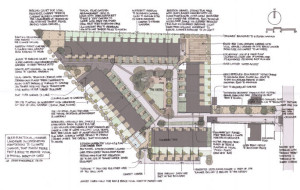
Mr McCloud has been keen to promote his environmental credentials. He’d also have us believe that he’s an imaginative developer. Now that his HAB company’s plans to infill an area behind Northern Road — what they have unimaginatively called The Triangle — have been submitted, we can judge for ourselves.

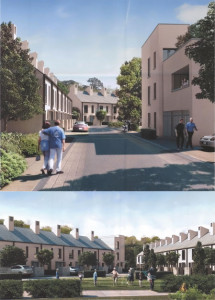
Not the Railway VillageLook at the two artist’s flights of fantasy. The scenes look just like the Railway Village, don’t they? Don’t they? They don’t. Gone is the pebbledashing of his earlier plans, replaced with render, allegedly to match the surrounding 1930s semis and, if the spin is to be believed, for its energy efficiency.

The development has been set out to achieve high-energy performance targets; this has led to us looking at rendered façade types as the most effective way of achieving these targets.

No doubt, the fact that render is a most effective way of hiding cheap materials underneath never crossed their minds.

They also claim that the monstrosities at the ends of their terraces are inspired by the Railway Village. To quote again from the planning application’s design and access statement,

Further south and just off the town centre is the Railway Village…. These terraces are generally terminated to their ends by a three storey building. The terraces have an area of defensible space to their front allowing for a degree of privacy, and compact well functioning yards to the rear.

Compact well functioning? That’s ‘small’ in plain English. And the three storey buildings in the Railway Village have considerably more in common with the surrounding buildings than Mr McCloud’s bland slabs have with the rest of his development.

McCloud packs ‘em inYou’ll notice in the artist’s impressions fantasies there’s plenty of large cars parked in front of the houses. That’s because despite earlier intentions, the reduction they’ve made in the number of parking spaces per house is concentrated entirely on the smaller, cheaper houses, giving a reduction of less than 30%. And what space they have saved by providing for fewer cars seems to have been used to pack more houses in rather than allowing more space around the houses. If you want a garden, this isn’t the place for you.

What the developers describe as a ‘Multi-functional, humane landscape incorporating adaptations to climate change that places people first & seeks to reduce visual & physical impact of cars’ to me looks — a few wooden fences excepted — incredibly similar to other developments in central Swindon.

Low-key worship: an essay in little boxes part 22

I’ve previously commented that the design of some of the public buildings proposed for the concreting over of Swindon’s front garden is, at best, ramshackle. Now it seems that a lack of funds will lead to the few religious buildings heading the same way.

The group called Swindon Churches Together has submitted a planning application for a place of worship portacabin, to be sited in the excitingly named Parcel 23 — or, as it now seems to have been renamed, The Stoweaway — of East Wichel, right next to the police point. I suppose we should commend them for choosing a design that will fit harmoniously with the surrounding development — the police point is also a portacabin.

The churches leading this plan are two local baptist churches, Old Town ecumenical parish and Wroughton Anglican parish. With such basic facilities, it’s not surprising that the group includes churches of a puritan persuasion. The supporting statement from the churches is an odd mix of pathos and over-optimism. First, the pathos.

The traditional church response in new housing areas has been to provide purpose built buildings for worship and with a view to community use. Christ the Servant Abbey Meads and Holy Trinity Shaw are two examples. The buildings have absorbed much money and local energy and with limited effectiveness.

Currently none of the major church denominations has funds available for the building of a church/community building in Wichelstowe.

So, new churches in north Swindon haven’t been a success, but they’d still like to build one in Wichelstowe if they have the money. With that logic, they should be grateful that they’re rather strapped for cash at the moment. Next, the over-optimism.

A new approach for community building
We would like to be on site as soon as possible offering moving day support and community information in order to welcome newcomers…. To fulfil this brief we would like to install a portakabin to work from that will also be a focus for early community activity. This might include a toddler groups
(sic), youth activities centre, a meeting place for community groups as well as a place for health professionals, council officials and members as well as other community activities.

That’s an awful lot to pack in to a single cabin that’s smaller than the homes little boxes being built around it. Unfortunately, in the current economic conditions, it’ll probably be the only community facility in Wichelstowe for quite some time. For that reason alone, one has can only wish them success.

Swindon Mela 2009

As always, Swindon Mela today was a great day out. Undoubtedly, it’s one of the best community events in Swindon’s social calendar.
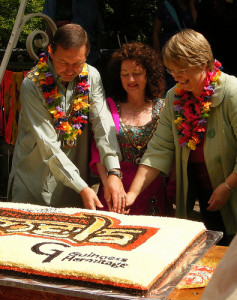
Cutting the Mela cake
Swindon Mela 2009
Swindon Mela Fashion Show

Developing the party line

It’s disappointing, but not surprising, that the vote at last night’s council meeting to oppose the Eastern Development Area proposals ended up dividing along party lines. It seems that the local red nest are totally ignorant of what their party’s mismanagement of the economy and distortion of the housing market has done, as illustrated by the comments of Mr Grant.

This plan will deliver much needed affordable housing to Swindon. We should be trying to make sure that the development is eco-friendly and includes green technology — we should back this development for the future of Swindon.

At the moment, just about the only building going on in Swindon’s northern and southern development areas is the construction of so-called affordable housing. And if you look at the prices of those ‘affordable’ houses, you’ll notice that most are more expensive than the equivalent allegedly unaffordable houses in other parts of Swindon. Forcing developers to make 30% of any large development ‘affordable’ just forces the average price of housing up without solving the underlying problem.

If you want to make housing affordable, the only way to do it is to ensure that supply exceeds demand. The recent collapse in the economy has done more to bring that about than market distorting government rules on affordable housing ever will.

A gullible partnership

The naïvety of the Swindon Community Safety Partnership continues to amaze. This week the Partnership’s leader, Mr Palusinki, is claiming that invisible marking of property reduces burglary by over 85%.

Effective property marking has reduced burglaries in other areas by up to 85 percent. Goods are less attractive to thieves if they can be easily identified.

Mr Palusinki is guilty of believing the manufacturer’s advertising material. The evidence on which those claims are based is weak.

An area containing approximately 500 homes was identified as being suitable for a pilot test to allow Police to assess the effectiveness of forensic property marking which is based on the principles of human DNA…. Within the ‘hot-spot’, 95% of the properties used the forensic marking ‘kits’, which included a large number of repeat victims, to mark their property. Signage, posters and window stickers were then used to deter criminals from operating in the area as well as significant media coverage…. The pilot was a huge success, with an incredible 85% reduction in domestic burglary, 60% reduction in theft from vehicles, and 50% reduction in theft of vehicles.

So in reality, it wasn’t the marking of property that caused the reduction in burglaries, it was the publicity that accompanied it that had the effect.

Mr Palusinki, it seems, is an advertiser’s dream customer.

Starvation postponed… slightly

It’s refreshing to see that Swindon Borough Council’s licensing committee has had the sense to ignore, for the moment, its officers’ recommendation to ban street traders from much of Swindon town centre. It has postponed making a decision because, without more detail about the regeneration which putting street traders out of business is meant to support, the case wasn’t well made. I suspect that even with more detail, the case for removing street traders wouldn’t be obvious. We already know much about the New Swindon Company’s plans for degenerating regenerating the town centre. Even in some of the grander plans that have now failed, there was nothing that would justify removing the street traders from the existing pedestrianised area. There’s also nothing in the council’s own licensing policy that would justify such a move.

Unfortunately for the street traders, there’s not much cause for celebration, as the European Union has plans to make their lives more difficult too. The proposal for removing street traders contained this little EU gem.*

the EU Services Directive takes effect before the 2010 season and seems to decree that consents (which are not renewable) cannot be preferentially offered to incumbent traders but must instead be opened up to competition (randomly chosen from those meeting the standard, not determined by a bidding process).

So even if the council’s decision is put off indefinitely — rather like the town centre regeneration — the existing street traders may lose their pitches in an EU instigated lottery anyway.

Anyone remember the ‘principle of subsidiarity’?

*A few words of caution: in a quick search of the EU’s directives I couldn’t find this directive. I am, perhaps, putting too much trust in Swindon Borough Council’s Head of Licensing.

Starving the town centre

It seems that Swindon Borough Council are unaware that we’re in the midst of an economic recession. Six months after they forced several street traders to move, the council’s licensing committee is at it again, this time with more draconian measures. They now propose to exclude all street traders from the main pedestrianised streets in the town centre (Canal Walk, The Parade, Regent Street, Regent Circus, Edgeware Road and Bridge Street). This will displace street traders that have only just moved following the committee’s last attempt at stifling street trading.

So, not content with there already being many empty shops in the town centre, the council now wants to get rid of street traders too. Under the proposals, street trading will be allowed in very few town centre streets. Farmers and continental markets will be allowed in Wharf Green (it seems that the council likes those); fast food stalls will be exiled to the site of the post office at Fleming Way. The only good news for street traders is that the fees the council charges them will be decreased. Given how little trade some of the permitted streets will allow, that’s no comfort to the street traders.

This commercial vindictiveness is, supposedly, to help regenerate the town centre.

This proposal relates to the 2010 Promise 35 that we will take all necessary steps to secure the regeneration of the town centre.

As the proposals are backed by the New Swindon Company — the quango whose only tangible contribution to the town centre’s regeneration has been demolition — it’s no surprise that the proposals are totally illogical. If the town centre was thriving and the street traders were in some way dragging it down, perhaps there would be some sense to it. But it is not, and will not be for some years yet. To claim that removing street traders contributes to the regeneration of the town centre is like claiming that sanding down a few rust spots would allow a broken-down car to pass an MOT.

Swindon’s blue nest councillors should be ashamed of the authoritarian leanings that this policy displays.