Tag: Swindon

Fly-tipping spin

If Mr Palacio of Swindon Borough Council is to be believed, the increase in fly-tipping in Swindon is because his team is doing more to clear it away.

Richard Palacio, Swindon Council’s environmental enforcement manager, said the increased number of reports of flytipping was down to extra resources being deployed by the council to combat the problem.

That’s as logical as the streets and alleyways of central Swindon are clean. The statistics announced by Defra show an increase in enforcement by councils across the country, not just in Swindon, yet there has been an 8% increase in recorded fly-tipping in Swindon, compared with a 9% decrease nationally.

Either Mr Palacio’s team are highly ineffective, or he’s talking rubbish in more ways than one.

Hidden statistics

I’ve been waiting for a couple of days to comment on the recently reported complaint statistics for Wiltshire Police. The figures quoted by the Adver don’t seem to add up.

The number of people making complaints against police in the county rose to 284 in 2008/09 – up from 234 the year before…. However, allegations made against police in Swindon fell from 175 to 148 over the same period…. Out of the 483 complaints made against Wiltshire Police, just over half (53 per cent) were locally resolved, which is the third highest nationally.

So is that 284 complaints or 483? Unfortunately, the Police Complaints Commission report to which the Adver refers has gone missing from their website: the links on their statistics page go nowhere for the 2008/09 statistics. What I can see, from last year’s report, is that the Wiltshire police were then subject of 234 complaints and 433 allegations. So it appears that in reporting the latest statistics, the Adver’s Ms Hilley has got a little confused between allegations and complaints. That’s despite writing in her report

People who complained made 1.7 allegations each on average.

To be clear: one complaint can cover several allegations. But then one can hardly blame Ms Hilley for being a little confused, as the press release — a fairly bland bit of whitewash — does its best to blur the distinction too.

As in previous years most complaints are about ‘neglect of duty’ (24%) and ‘incivility’ (21%), essentially being rude and late. The proportion of all allegations that are substantiated is 10%.

There, in just two sentences, they heave a large dollop of mud into the already less than crystal clear statistical waters. With complaints nationally rising steadily in recent years, it’s no doubt something the government would rather not be that clear about.

Discouraging response

I’ve spent much time recently completing my comments on Swindon Borough Council’s Core Strategy. It was pleasing to see that many comments on the earlier draft seemed have been taken into account.

Whilst the council’s officials may be responsive to the comments they receive on their strategies, there seems to have been little effort to make it easy to submit those comments. The online response form remains as poor as last time. And unlike last time where any means, within reason, of submitting comments was accepted, for this final stage of consultation only comments on the official forms were accepted. Unlike a printable form, where one can see what’s coming next, with this online form that’s not possible. So just copying the words from the printable form onto the online form — which is what’s been done in this case — doesn’t work. It was a case of filling in one screen of the form, moving onto the next screen, only to find it asking for something I’d put on the previous screen, resulting in lots of clicking back-and-forth to cut-and-paste material into the right section of the form.

It’s also noticeable that in all their consultations, Swindon Borough Council’s Forward Planning Group give little publicity until the final round of consultation. So in the earlier rounds — where the planning rules allow people to have real influence — there are few comments, with many of those that might have something to say unaware until the final stage where the rules are very restrictive. And the Adver played along with an almost continuous dripdrip of stories based on this version of the Core Strategy, but was almost silent during the earlier rounds, even though the proposals now highlighted were in previous versions of the strategy. It’s good that they’ve covered the story, just unfortunate that they left it so late.

Finally, two predictions for the next round of the process, examination of the strategy by a planning inspector. The first is that the Save Coate campaigners will try to make it a one-topic examination, in much the same way as the New Mechanics Institute did with the Central Area Action Plan. The second is that, like them, they’ll again be unsuccessful.

No Wills to continue

There are some things that are predictable in politics. For example, the candidates of a losing party in an election can be guaranteed to say that the winning party did badly… in comparison with predictions of success that a few hours before they would have disclaimed as nonsense. Similarly, except for those departing for health reasons, every MP that chooses not to fight an election would have us belief that this was a decision they’d been planning for a long time. The likelihood of defeat never, apparently, clouds their judgement. Thus yesterday’s news that Mr Wills won’t be hanging around for almost inevitable defeat at the next election comes with claims that he always planned it this way.

I have always believed politics is an act of public service, and that it was probably right that no MP should serve more than three terms.

On that basis, his own leader should have departed long ago, but Mr Wills doesn’t seem inclined to suggest that his boss follow his lead.

I have full confidence in the Prime Minister…. I don’t believe he has been given enough credit for helping this country to move out of recession.

Many would say the Prime Minister hasn’t taken enough credit for getting the country into this recession. But lets not let reality get in the way of Mr Wills’ musings.

This has been a good Government and history will say that this Government has changed the country for the better.

If by ‘good’ one means taking the country to war on the basis of forged evidence, then maybe. If by ‘good’ one means taking the country into its worse recession for eighty years and racking up massive debts, then maybe. If by ‘good’ one means massively restricting civil liberties with anti-terrorism legislation of limited, if any, effectiveness, then maybe. But lets not let reality get in the way of Mr Wills’ musings.

This Government has made a huge difference to Swindon and has enabled huge transformation to the town.

Forcing the town to expand its population by almost 20%, whilst saddling the town with an urban regeneration company that has almost single handedly — with a little help of the aforementioned recession — converted the town centre into a demolition site is not a transformation to be proud of. But lets not let reality get in the way of Mr Wills’ musings.

Mr Wills has been the lesser of Swindon’s two parliamentary evils. As a constituency MP, he was markedly better than the government’s representative in South Swindon, Ms Snelgrove, but then that isn’t difficult to achieve. He also published a thorough breakdown of his expenses, many months before other MPs grudgingly succumbed to pressure from the public and did likewise. But none of that makes up for a voting record that speaks for itself — though again it’s better than the record of his South Swindon compatriot.

Mr Wills says standing down was a difficult decision to make.

It was a very difficult decision…. This was not a sudden decision; it was one I have been mulling over for the past year.

Given the opportunity, his constituents would have very easily made the same decision for him.

A short memory

Agreeing with Mr Feal-Martinez hasn’t been something that’s featured much in my warblings. I doubt that’ll change either but, as he’s standing down from representing UKIP in South Swindon, primarily on health grounds, I wish him well, without qualification. Which is more than the government’s representative in South Swindon, Ms Snelgrove, did, as she chose to preface her good wishes with some propaganda.

This just goes to show that UKIP is in real trouble in Swindon and I’m not surprised that Robert has found it necessary to stand down.

Hmm… seems she’s already forgotten the large increase in the vote for a certain party at the euro-elections in June.

Westcott area then and now

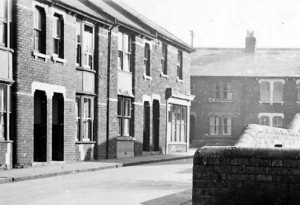
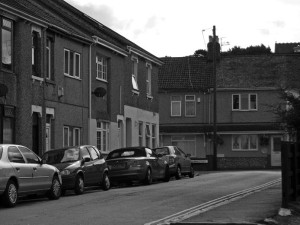
The Swindon Local Studies Collection at the Central Library have been busy over recent months putting images from their collection onto Flickr. As they’ve recently added several of the local area, komadori has been out-and-about to photograph some of the same views today.

(Archive images below are Swindon Local Studies Collection; 2009 images are © komadori.)

Joseph Street looking towards Albion Street in 1954…
Joseph Street in 1954
and Joseph Street today.
Joseph Street in 2009

Marlborough Street looking towards Wescott Place in 1954…
Marlborough Street in 1954
and Marlborough Street today.
Marlborough Street in 2009

Wilts & Berks Canal in 1914…
Wilts & Berks Canal in 1914
and Canal Walk today.
Canal Walk in 2009

No stars

Swindon Borough Council’s latest ‘scores on the doorsnews release has received plenty of publicity. But whilst the complacency of some of those in receipt of a zero star rating is to be deplored, the criticisms of the scoring by some more highly rated* cannot be ignored. The criticism is that the inspection regime is too paper based: an establishment can fail for not filling in the right paperwork, but can pass with poor hygiene if the paperwork is fine.

The information about what contributes to a restaurant’s star rating is rather well buried on Swindon Borough Council’s website. The criteria set-out by the government’s Food Standards Agency for assessing a ‘food business’ are:

  • type of food and method of handling;
  • method of processing;
  • consumers at risk;
  • level of current compliance with food hygiene and safety procedures;
  • level of current compliance with structure of premises;
  • confidence in management and control systems;
  • risk of contamination of food.

But of those, the only three that contribute to the ‘score on the door’ are:

  • level of current compliance with food hygiene and safety procedures;
  • level of current compliance with structure of premises;
  • confidence in management and control systems.

Oddly, ‘risk of contamination of food’ — logically the most important to the consumer — does not contribute to the score. Which might explain why the official definition for a zero-star rating is

Serious non-compliances found but no imminent risk to public health.

Until there’s an inspection regime that’s concerned more about food hygiene than it is about correct paperwork, my choice of restaurants will remain undisturbed.

* At which point I would have liked to have linked to their five star rating, but the council’s search result was broken.

Farewell Mr James

It has been announced that the New Swindon Company’s Mr James has stood down, apparently by Mr Richards of the South West Regional Development Agency.

Swindon has a problem with a negative image. We need to bring together the marketing of the town and the delivery of regeneration all under one roof. That is what’s behind the restructuring of the New Swindon Company. We are very satisfied with what Peter James has achieved and we wish him well.

Mr James seems to have a track record here. According to his profile, he has left a regeneration programme unfinished before.

Prior to joining The New Swindon Company, he spent three years with Tees Valley Regeneration as Director of Development.

A feature of Mr James’ leadership has been severe over-promotion of every minor step. Lets hope his replacement is someone capable of completing the job. One other point from the announcement stands out.

We need to bring together the marketing of the town and the delivery of regeneration all under one roof.

So far, much of the ‘marketing’ has been done by the New Swindon Company, but whenever it comes to ‘delivery’ Swindon Borough Council gets involved. If this is all to be brought ‘under one roof’ whose roof will it be?

Picture this… eventually

Last September, I commented on plans to set-up a central control room to monitor CCTV footage from the town centre that was acknowledged as being of questionable value. Almost a year later, and Swindon’s lollipop fans, the Swindon Community Safety Partnership, are once again talking about setting up a central CCTV control room, plus at least five more cameras to add to the forty already in existence in the town centre.

For someone who’s a volunteer policeman, Mr Palusinski, head of the Safety Partnership, has an almost criminal disregard for evidence.

The new system won’t be a case of Big Brother watching you – it is to tackle issues of crime and disorder in the town while making residents and shoppers feel safe.

Err… regardless of what it’s being used for, unless the control centre is left empty and unused, it will be a case for the big-brother state watching.

These area may be parts of the town that are heavily affected by violent crime, graffiti or purse dippings and aren’t covered by sufficient surveillance.

So that’s CCTV being used to monitor the crimes that the evidence shows it’s least effective in tackling (i.e. anything other than theft from cars in car parks).

The amount of money that will be spent on updating the network will be far outweighed by the savings that will be made by having one central control room instead of having to communicate with several different agencies.

Given that the Safety Partnership’s own report acknowledged that 80% of CCTV footage is of questionable value, it seems to me that the money spent updating the network will be a waste of money.

I’ve been monitoring the ‘initiatives’ of the Swindon Community Safety Partnership for over eighteen months now. I’ve yet to see anything that suggests their naïve leadership are doing anything other than wasting Swindon taxpayers’ money.

Update, Monday, 24 August 2009: To reinforce my point, an internal police report has found that of London’s more than a million CCTV cameras, only 1 in 1000 contributes to solving a crime each year. So Swindon’s cameras are likely to be useful less than once every 20 years.

Insecure marketing

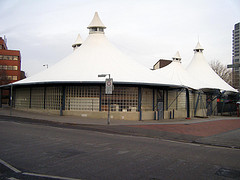
Back in business soon?It’s nice to see that the tented market may soon be back in business. But given the state of the economy, it seems odd that the market’s new owners have chosen to increase rents by 60 to 100%. They say that rents need to go up to allow them to make a profit. Well, yes, but the previous operators of the tented market wouldn’t have stayed in business for as long as they did if they were making a loss so big that it could only be cured by a hike in rents as vast as this.

What would tenants get for these inflated prices? Insecurity, though that’s not how the new owners see it.

The six month lease is there to give security to us and the traders.

The risk of being evicted within months of opening a new business isn’t what many would describe as ‘security’. Flexibility: yes. The ability to cut ones losses if the new venture isn’t a success: yes. Security: most definitely not.