The developers Clarebrook and their interior designers architects Pennington Robson are back with revised plans to replace Swindon’s tented market with what they rather fancifully describe as a ‘pavilion’.
Now, credit where credit is due, the revised plans are an improvement on their last ones. That’s not a great endorsement. Their last design was incredibly ugly. So ugly that the planning committeedeferred decision on them. The appearance from Commercial Road in the new plans is improved. However, anyone approaching from Farnsby Street — which, as a result of the one-way system, many do — will see a building remarkable only for its drab ugliness.
It would be very easy to sit here and be full of doom and gloom about the year to come. But I think we have got grounds to be optimistic. We are on a long journey and it doesn’t matter how much flood water there is we will keep on that road. We are focussed on business as normal but we have to be realistic about the challenges that will face us.
To me that reads as though he believes regeneration will continue but not at the same pace as was originally hoped. To the Adver, it translates as ‘full steam ahead’. You don’t need to have listened to much political spin to know that when a politician talks about a ‘long journey’, the journey will be longer than they originally predicted. With the forthcoming signs of progress being yet more demolition — this time at the former Swindon College site — rather than construction, Mr Bluh’s ‘optimism’ is little cause for excitement.
Reading of the wish of the headteacher of Drove Primary School to open a youth facility in his school’s grounds, I am struck by how this contrasts with the wishes expressed by residents elsewhere in central Swindon to restrict access to Robert le Kyng School, because of concerns over vandalism, drugs and underage smoking and drinking. Although some of the problems are different, perhaps the solution here too should include greater use of the school grounds rather than less.
A success of Swindon Borough Council that goes relatively uncelebrated is the carrying forward of elements of the corporate games held in Swindon in 2006, so that there has, since then, been an annual sporting event, the Challenge Swindon Festival of Sport. The most visible, and fun, of the sports within the festival has to be the dragon boat racing on Coate Water which took place today. If nothing else, the frantic paddling of some teams, apparently oblivious to the beat from their drummer, provides some amusement for spectators. Hopefully the Festival of Sport will outlive the two-year funding for Challenge Swindon.
I’m sure that when the police describe something as ‘unusual for Swindon’ the impression they want to give is that it does no happen very often. With, according to recentreports, estate agents in both Stratton and Swindon town centre having been shot at using ball bearing guns, and a travel agents in Westcott Place similarly targeted, all within the last couple of weeks, I’d say that is unusual in the opposite sense. I really don’t care whether, to quote the police again, ‘The offences take place on an ad-hoc basis’ or not. Seven attacks in two weeks may be ad-hoc but is also rather frequent. It deserves a rather greater sense of concern from the authorities than is apparent at the moment.
I’ve received a survey to fill in from Swindon Borough Council, titled ‘Life in Swindon Survey’. If the opening blurb is to be believed, its purpose matches its title.
We would like to hear your views about life in your local area and about issues such as, anti-social behaviour, leisure activities and your health. Your view will help us to plan our future services around residents’s priorities.
The survey itself though has very few questions specifically about ‘Life in Swindon’: only four out of thirty two. Three of these make up the entirety of the ‘Culture & leisure’ and ‘Your feelings about your local community’ sections (one on which attractions have been visited, one on satisfaction with Swindon town centre, and one on problems in the ‘local area’) and the other (on local adult education) is in the ‘Work and skills’ section. The section titled ‘Your community’ is virtually nothing about the community and almost everything about the individual filling in the form, with two questions about individual involvement in voluntary work, another on individual ability to influence decisions and only one on the community (about how well people from different backgrounds get on). Seven of the thirty two questions are standard demographic questions used primarily for classifying respondents. Having filled it in, I feel like I’ve been answering a survey that’s more about me than it is about Swindon or ‘Life in Swindon’.
I can’t help feeling this was a wasted opportunity. Much of the survey seems to be seeking information obtainable from other government agencies. What little’s left was hardly worth the effort — and possibly not the consultants’ fee either. There’s so much more to say on ‘Life in Swindon’ than answers to three questions can tell.
Just three months ago there was that most ‘innovative’ campaign in Fleet Street, using lollipops as an antidote to drunkenness. Now, in yet another great medical advance, a unit of Swindon Borough Council is reported to be attempting to fight drug addiction by handing out mugs and pens.
I think I might set up a consultancy business, advising councils on how to reduce gun crime by handing out chocolate biscuits. With councils like Swindon’s around, I’m sure I’d make a fine profit….
It must be confusing at times, working in the local public sector. The interconnections between organisations seem so incestuous at times that I’m surprised that people don’t end up spending much of their time talking to themselves. For example, I read that the Swindon Summer Festival is a partnership of Swindon Borough Council, Swindon Cultural Partnership, inSwindon and the Marriott Hotel. So that’s the council in partnership with two of its own partnerships and a hotel.
If you’re looking for a beacon of efficient organisation… this isn’t it.
I’ve heard a slightly different explanation from any given so far of why Swindon Borough Council wants to build a canal along its chosen route. The explanation came from one of the canal trust’s officers.
One of the features of Swindon’s traffic highlighted in the council’s Central Area Action Plan is the high proportion of traffic that passes through the town centre. The plan aims to reduce this, so that most of the traffic left is actually going to or from the town centre rather than just passing through. The aforementioned canal trust officer said the reason the council wants to build a canal down Faringdon Road and Fleet Street is as part of that traffic management scheme. So the potential traffic congestion that our recently elected councillor was complaining of in his election campaign would be intentional rather than an unwanted side-effect.
I’m not sure how good the canal trust officer’s information source is, but it’s certainly a slightly different slant on the possible benefits of a new canal.
Update, Tuesday, 13 May: To clarify, the canal trust officer’s view was that the main reason for building the canal down Faringdon Road was for it’s traffic management effects rather than because, as the council have said, that would be the best place in terms of its civic amenity and tourist attraction value.
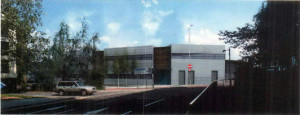 The developers Clarebrook and their interior designers architects Pennington Robson are back with revised plans to replace Swindon’s tented market with what they rather fancifully describe as a ‘pavilion’.
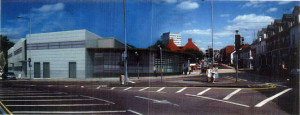 Now, credit where credit is due, the revised plans are an improvement on their last ones. That’s not a great endorsement. Their last design was incredibly ugly. So ugly that the planning committee deferred decision on them. The appearance from Commercial Road in the new plans is improved. However, anyone approaching from Farnsby Street — which, as a result of the one-way system, many do — will see a building remarkable only for its drab ugliness.

