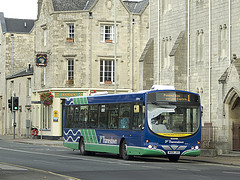
Missing the bus

It’s difficult to understand how the management at the Great Western Hospital managed to get their plans for providing a staff bus service so wrong. Just three weeks ago, they were effusive about the likely level of usage.

The service will be up and running by January 4 and after speaking to staff about the plans, many have said it is a service they will be glad to use… staff would find it more convenient as many have to pass Honda to get here anyway.

Now the £30,000 scheme that was intended to free-up 200 parking spaces has been shelved for lack of interest. Now I’m sure that the hospital management know where their staff live, but if most of their staff pass the Honda site on the way to work that suggests that either the hospital is staffed almost exclusively by residents of Highworth or that staff from around Swindon like to take a tour of Stratton on the way to work.

For much of the twentieth century, many large employers ran staff buses. Surely it’s not that difficult to get right?

Diligence

One thing that seems to be absent in Swindon’s free wi-fi fiasco is due diligence. Mr Bluh would have us believe that due diligence occurred before Swindon Borough Council loaned a start-up company £450,000 of our money to provide ‘free’ wireless internet across the borough.

As for whether due diligence was followed, of course we looked at the risks and exposure of the investment. There is absolutely no requirement for us to seek third party independent advice. We have successfully concluded many multi-million deals and transactions and, as a result, have built up a high level of legal, commercial and technical expertise.

Others disagree. Evidence of due diligence is certainly hard to find. The published advice given to Mr Bluh and Mr Edwards is limited. The advice stated that the company was more likely to pay the council’s loan back late than to completely default. It also stated that the likelihood of the council getting a return on its shareholding was strongly dependent on the company’s marketing campaign, yet at the time the company did not have a formal marketing plan. Just how weak would a business proposition have to be for these two councillors not to squander our money on it? This is also the council’s first public/private venture, according to an article in the council’s own newspaper. So the expertise available in the council is more limited than than is being suggested.

Mr Bluh would also have us believe that this £450,000 could not be used for other purposes.

The money invested in Digital City cannot be used to plug a gap in our budget or operating services, it forms part of a sum we would normally invest in order to get a better return for the council.

Just how naïve does he think we are? Transferring money from reserves is commonplace amongst councils when times are tough, as shown in Swindon Borough Council’s own accounts.

Theres also the matter of whether this boroughwide wifi service should have been put out to tender, as a procurement exercise. The Swindon branch of the Federation of Small Businesses believe so, and that the council is disadvantaging local businesses. Once again, Mr Bluh would have us believe differently.

We have been looking at providing free Wi-Fi for the last three years as part of ‘Swindon’s Digital Challenge Proposal’ and it is only recently we have been approached by Digital City UK who had a technical partnership with aQovia. They came to us because they wanted to set up services to sell in Swindon and we invested in them, so we have not disadvantaged any other businesses in Swindon.

But if it was part of the council’s policy to provide such services would they not have eventually offered a contract to supply these services if this offer hadn’t been made? And isn’t Mr Hunt — as chair of one of the council’s bureaucracies, the Swindon Strategic Economic Partnership, and a board member of several others (SSP, TNSC & SCS) — someone with rather better access to the council cabinet than most? This is not some unconnected company coming along with a commercial proposition: Mr Hunt and the council have been closely connected for many years. And as a consequence of that we, the Swindon taxpayers, seem to have been landed with a deal with far less financial security than a properly procured service would provided.

It’s not enough for the process to be, as Mr Bluh regards it, not only above board but robust. It also needs to be seen to be above board. At the moment, all that can be seen is a fog of secrecy and spin, mixed with smoke from taxpayer’s money burning.

Still protesting too much

Mr Wills — who is suspending his website in a few days’ time because he can nolonger use our money to subsidise his political ramblings there — like so many of his colleagues just does not understand the public outrage over MPs’ expenses. Like many, he continues to protest his innocence for financial errors — errors which if made by his constituents would get little if any sympathy from the state.

To Mr Wills there’s nothing wrong with using a disallowed claim as an excuse for not paying back an overpayment of expenses.

[A] series of accounting mistakes result[ed] in double payments of claims by the Fees Office. I deducted from the repayment the amount I was owed by the Fees Office for receipted train fares to and from my constituency. The Fees Office has still not paid this because they say the claims were submitted 16 days after a deadline they had imposed, despite the fact they are entitled to waive the deadline.

Imagine missing a deadline for filing details for a tax claim, then using that as an excuse for not paying income tax. It wouldn’t work: the Inland Revenue would not be sympathetic; neither, I suspect, would Mr Wills. Yet he expects our sympathy for doing much the same thing.

By the standards of many of his MP colleagues, Mr Wills has been relatively well behaved financially. But when it comes to understanding the mood of the electorate on this issue, he’s as out-of-touch as the rest of them.

Unplanned

It now seems that there’s more than just the marketing plan that’s been forgotten by the company setting up ‘free’ borough-wide wireless internet in Swindon at our expense. From the latest comment by Mr Hunt it’s obvious that even the plans for setting up the wi-fi are vague.

It won’t be fully functional in Highworth until probably about January 15. After that we will have a better idea.

Probably about? Just what sort of commercial delivery plan is as vague as that for a deadline just three working weeks away? This also suggests that last week’s ‘launch’ of the wifi service in Highworth was a sham and nothing more than a publicity stunt.

For a project that’s costing us almost £½M, I expect something far more robustly planned and thought through than this. I expected our council leaders to have demanded such robustness too, before they used our money for this speculative investment.

Listening to the buses

Lightning is now rather chatty. Photo © komadori.

The recent announcement by Thamesdown Transport (which was regurgitated almost verbatim by Swindonweb) seems to have missed the wider uses for on-bus announcements of the next stop. One of the passengers that they have used in the press release, Mr Trevennen, is rather more aware.

It’s not just the visually impaired who benefit but passengers who are new to the town or are visiting.

The system has been introduced on what the company calls ‘six key routes’: the 1 & 1A to West Swindon, 2 to Covingham, 13 & 14 to Eldene and Haydon Wick and 17 between Penhill and Park North. Except for the short hop between the railway station and the Outlet Centre these are probably not services used by many visitors to Swindon. Route 16 to the hospital might be a better choice, or some of the rural routes, such as the 47 to Lambourn with onward connection to Newbury, or the 48 & 48A to Marlborough. Or to benefit those new to the town, why not service 18 to Priory Vale or 11 to Wichelstowe?

Perhaps Thamesdown Transport should listen more to its passengers.

Bradshaw admits public sector recruitment bias

Mr Bradshaw has recently announced the creation of over 600 publicly funded jobs to massage the unemployment figures help young unemployed people into work. The jobs are, almost without exception, in the public sector, including 142 at the National Monuments Record Centre in Swindon. According to Mr Bradshaw these jobs usually go to rich kids.

[T]hese are great jobs — jobs in sectors that can be really tough to break into, that are usually the preserve of better off children whose parents have the contacts to get them a foot in the door.

Err… so he’s saying that after twelve years of his government and all its bluster about inclusiveness, recruitment to public sector jobs is biased, favouring the wealthy with contacts, rather than recruiting on merit.

It’s nice of Mr Bradshaw to confirm that the old boy network is alive and well under New Labour.

Insecure

A document uncovered by kecl over on TalkSwindon shows that Swindon Borough Council’s £450,000 loan to the company installing wifi across the borough is far from secure.

The new company will need to generate sufficient income to repay the loan provided by the Council. Should this not be the case, security is provided through the loan agreement which requires transfer of the ownership of the company’s assets to the Council in the event of default. The physical assets will be purchased at a cost of around £250k

What the cabinet briefing to Mr Bluh and Mr Edwards doesn’t mention is what those physical assets might be worth once installed: no doubt considerably less than £250k. Still, never mind, the council would have a share in an unsuccessful network and a defaulting company.

In addition there will be value in the virtual network that will cover all of the Borough and in the Council’s shareholding in the company.

The document also indicates how woefully unprepared the company was just a couple of months before launching the service.

While providing the loan is not without risk, based on the Business Case it appears that the risk that the loan repayment period may need to be extended is more likely than the risk of complete default…. The success of the company, particularly in the early stages, and consequently the potential for Swindon Borough Council to achieve a return from its shareholding will depend to a large extent on the success of the marketing campaign. A formal marketing plan has not yet been developed, but a Brand Consultant and Marketing Specialist have been informally assisting the project.

So that’s a loan made of the basis of a business plan that lacks a plan for what financially is its most important part.

Over 50% of households in Swindon already had broadband access in 2006. That’s half the potential market for the new company’s paid-for services gone before they even start. Many of the remainder are likely to have neither the interest nor the money to pay for wifi services either. The business case must be very optimistic.

According to the document, the report and its recommendations were approved by the two cabinet members without reference to the rest of the council’s cabinet. The issue has now been referred to the Audit Commission.

Uncommercial

It seems that Mr Bluh does not understand what the role of a local council is. Primarily councils exist to provide services, such as social services and education. At their core are services taken over by councils as the Poor Laws were reformed, then abolished and replaced by the welfare state, plus a few other tasks inherited from the courts.

One thing that has never been at the heart of council business is commercial speculation. Mr Bluh seems to be unaware of this.

This is a commercial decision, in the new world in which we all live more and more commercial decisions will be made. An opportunity was put to us, and we were asked if we wanted to invest…. Had we not done it the way we did, the deal would not have gone through.

Had Swindon Borough Council made the decision to invest £450,000 of our money in a wi-fi venture in a more open way, it may well have been found that it was perfectly right and proper for the deal not to go through. Unfortunately, very few seem to have been asked for an opinion.

We don’t do anything without considering the implications. But we would not have done this had it not been in accordance with council policy.

I don’t recall gambling on start-up companies being a council policy.

This is a commercial venture that will bring commercial return. The only affects on capital budgets will be if this loan does not get repaid in full.

Has Mr Bluh not noticed that the economy is in rather a mess? That defaults on loans are much more commonplace than they were a couple of years ago? This is a commercial venture that may bring commercial return, but could equally bring losses. To remind him of something he said very recently.

To get a reasonable level of council tax and to go forward we have been required to find savings and efficiencies. We are doing everything that is humanly possible to keep this ship afloat.

Speculating almost £½M on a commercial venture in an already very crowded and competitive market does not look like ‘doing everything that is humanly possible’ to me.

If I wanted to speculate on commercial ventures, I’d buy some shares. With those shares comes the right to vote to remove the executive. And if others didn’t agree with me I could sell the shares and take my money elsewhere. None of those options are available when it comes to a council. The council takes my money in council tax regardless of whether I agree with what it does: there is no option to sell out.

I expect the council to provide services, not to indulge in commercial speculation. Whatever Mr Bluh may think, the council is not a business, it’s a council, and it is not subject to the commercial rigours that business is. If I want to invest my money, I’ll chose where to invest it myself thank you. I don’t expect some has-been lawyer and a bunch of bureaucrats to speculate with my money without asking first.